Building research partnerships in Tanzania: early engagements for After the Single Use
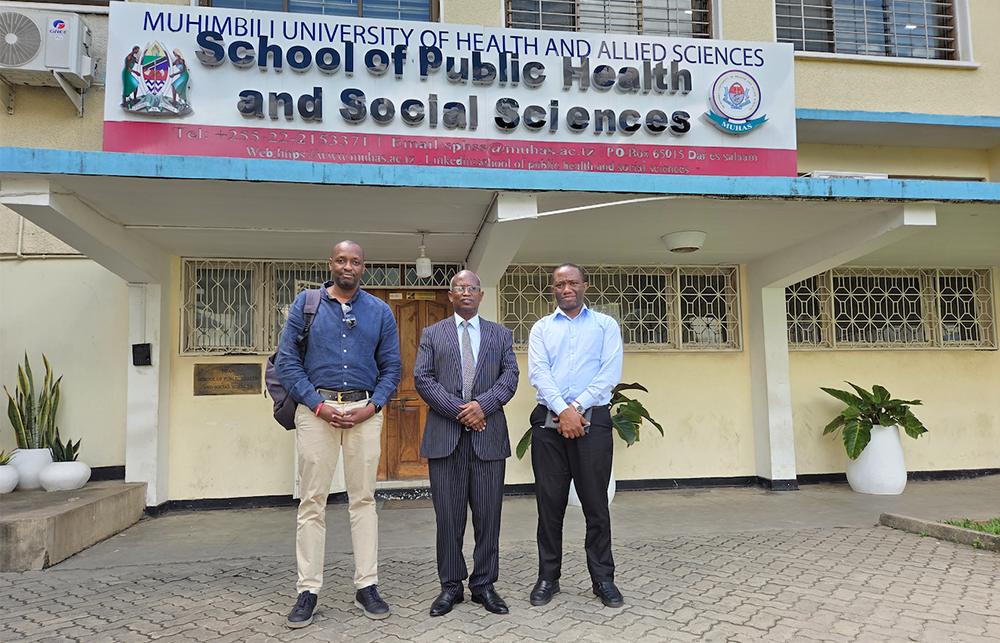
(left to right) Peter E. Mangesho (project country lead for Tanzania), Dr Amaniel Amani (Post doc Fellow at After the Single Use, Tanzania), and Dean of the School, Professor Deodatus Kakoko at the School of Public Health and Social Sciences in Muhimbli.
Body
As preparations continue for the launch of the Tanzania component of the After the Single-Use project, members of the Tanzania research team recently conducted a series of institutional and stakeholder visits in Dar es Salaam to build collaborative relationships and strengthen local engagement with the project’s themes.
Over the course of three days, the team met with academic leaders at the Muhimbili University of Health and Allied Sciences (MUHAS) and visited the environmental advocacy organisation Nipe Fagio to explore opportunities for collaboration, student engagement, and public dialogue on the growing reliance on single-use medical plastics in healthcare systems.
The visits were part of the project’s broader effort to establish interdisciplinary and cross-sector partnerships to support research on single-use medical devices, healthcare waste, and the environmental consequences of contemporary biomedical practices in Tanzania.
Biomedical Engineering Department
Biomedical Engineering is among the key departments in the School of Biomedical Sciences under the College of Medicine at MUHAS. Apparently, the department merges hardware and software engineering within the field of Biomedical Engineering, creating an influence across many clinical and non-clinical departments both within and outside Muhimbili University of Health and Allied Sciences. This influence has the potential to drive technological advancement in different forms across diverse departments. The meeting aimed to introduce ASU project and discuss potential areas for collaboration in its implementation.
The Acting Head of Department, Dr. Ramadhan Rashid, stressed the importance of collaboration between other departments and projects with their department in order to make the best use of the department’s expertise and resources. Furthermore, ASU emerged as an important area for collaboration, prompting a rethink of the past, present, and future use of plastics in healthcare. The Acting Head pointed out plastics as one of the major areas of concern, as they cut across almost all aspects of Biomedical Engineering. He noted that only plastic bottles used outside healthcare facility settings are categorized for recycling, while plastic medical waste has not yet been classified for recycling. This presents an important gap that warrants further research and engagement. The research team was informed that single-use plastics in healthcare involve both technological and management challenges. Currently, most single-use plastics generated within healthcare facilities are disposed of directly at dumping sites or through incineration, whereas plastics used outside healthcare facilities often follow different disposal pathways. Existing technologies do not adequately provide opportunities for the further reuse or recycling of plastics in healthcare settings.
The Acting Head of Department pointed out students’ final-year research projects as a potential area for collaboration between the project and their department. He also promised further engagement of students in public lectures and other project activities that align with the department’s ongoing work. Both parties agreed to hold further meetings between the Biomedical Engineering Department and the ASU project to strengthen collaboration and make the best use of the available resources from both sides.
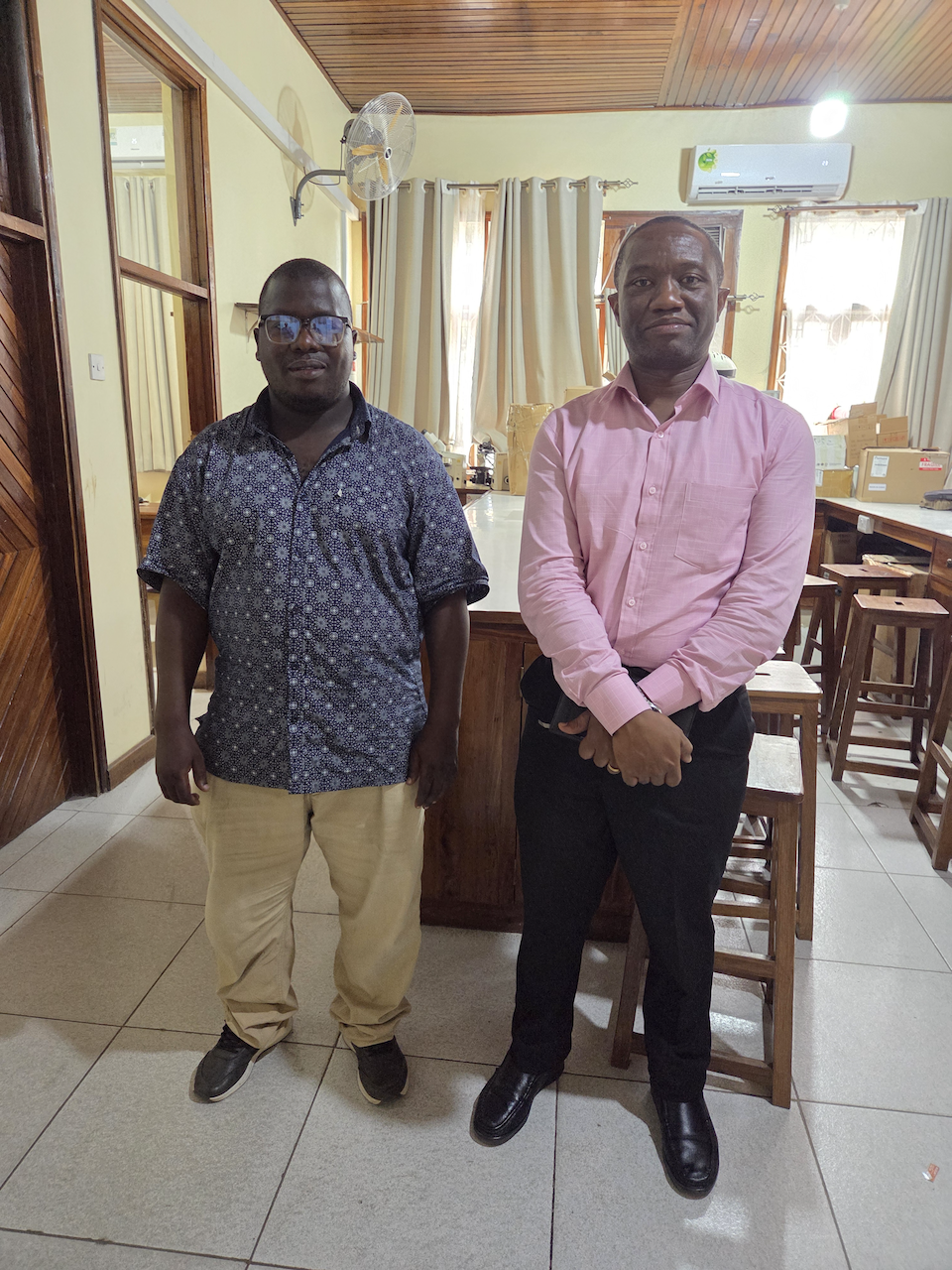
Dr Amani with the Acting Head of the Department of Biomedical Engineering, Dr Ramadhan Rashid, at his Office
Conversations at the School of Medical Diagnostics
The School of Diagnostics includes all departments responsible for different types of disease diagnosis and the diagnosis of other medical conditions. It is responsible for training, research, and consultancy services. Training is provided to both undergraduate and postgraduate students undertaking most of the courses offered at Muhimbili University of Health and Allied Sciences. The school provides great potential for collaboration with the ASU project, given its cross-cutting role across the designated research domains. The processes of diagnostics deals with equipments and consumables.
One of the key meetings took place at the School of Medical Diagnostics at MUHAS, where the team was received by Dr Asteria Kimambo, who was Acting Dean-School of Diagnostics. Discussions focused on the increasing dependence on single-use medical devices and disposable materials within clinical training and healthcare practice.
Dr Kimambo acknowledged that disposable medical products are now deeply embedded in many areas of healthcare delivery, largely because they are perceived as essential for infection prevention and patient safety. In settings where concerns about contamination and hospital-acquired infections remain significant, disposable materials are often understood as unavoidable components of modern healthcare infrastructures.
The discussion also highlighted how teaching institutions themselves contribute to the growing circulation of disposable medical materials. For example, students in clinical training are frequently required to use disposable gowns and other single-use protective equipment during practical sessions. While these materials are considered necessary within current infection-control frameworks, the conversation opened up broader questions about sustainability, waste generation, procurement systems, and the long-term environmental implications of disposable healthcare cultures. Most diagnostic procedures originating from different clinical departments are plastic-based and rely heavily on single-use materials. The discussion also revealed that most diagnostic departments store their samples in glass containers for potential future use
Importantly, participants also reflected on the possibility of reducing unnecessary use in certain areas without compromising patient safety. The team discussed how the project could contribute evidence and comparative insights that may help institutions think critically about where reductions, substitutions, or alternative practices may be feasible.
Strengthening Research Collaboration and Student Engagement
The team also met with the Dean of the School of Public Health and Social Sciences at MUHAS Professor Deodatus Kakoko to discuss how the project might support postgraduate training and collaborative research in Tanzania. The school has total of seven departments of both natural and social science nature which are important to ASU project.
A major outcome of the meeting was a shared commitment to involve Masters students in research activities connected to the project. The idea is to encourage postgraduate students to develop dissertations and theses that engage with questions surrounding single-use plastics, healthcare infrastructures, waste management, environmental health, and sustainability in medical settings. These students would potentially work closely with the Tanzania research team, including the country lead and postdoctoral researchers, alongside supervisors from MUHAS.
This collaboration is expected not only to support local research capacity but also to create opportunities for interdisciplinary scholarship that bridges public health, anthropology, environmental studies, biomedical sciences, and policy research.
The meeting also resulted in plans for a public lecture to be held later in the year, where the project’s Principal Investigator is expected to speak on the global and local challenges posed by single-use plastics in healthcare. The event is envisioned as a platform for wider engagement with academic staff, students, policymakers, and healthcare practitioners from institutions such as Muhimbili National Hospital, which is anticipated to become one of the study sites for the Tanzania research activities.
Engaging Environmental Advocacy Organisations
Beyond university engagements, the Tanzania team also visited Nipe Fagio, a local environmental NGO known for its work on waste management, climate activism, and plastic pollution campaigns in Tanzania and internationally.
The visit aimed to explore how civil society organisations working on environmental justice and waste reduction might intersect with the concerns of the After the Single-Use project. In conversation with their Data coordinator Mr Tajaeli Masaki we learnt that Nipe Fagio has extensive experience organising community clean-up campaigns, conducting waste audits, and advocating for stronger action on plastic pollution through its “zero waste” initiatives . The organisation has also participated in international conversations around the Global Plastics Treaty.
During discussions, the team learned that healthcare-related waste, including medical plastics, has occasionally been found discarded in informal dumping areas and along waterways such as the Msimbazi River. These observations point to important but often under explored questions concerning the disposal, leakage, and governance of medical waste within urban environments.
Although Nipe Fagio does not currently work directly on single use medical plastics, both sides expressed interest in continuing conversations around possible future collaboration. Such engagement may become increasingly important as debates around healthcare sustainability, waste governance, and environmental accountability continue to grow in Tanzania and globally.
Looking Ahead
These early visits underscore the importance of building relationships across universities, healthcare institutions, and civil society organisations as the Tanzania component of the project begins. They also reveal the complex position of single-use medical plastics within healthcare systems: materials that are often framed as indispensable for safety and hygiene, yet which simultaneously generate new environmental and infrastructural challenges.
As the project moves forward, the Tanzania team hopes to foster conversations that go beyond technical questions of waste management alone. Instead, the research will examine how disposable medical materials are tied to broader histories of public health, global health governance, clinical practice, consumption, risk, and environmental change.Through collaborative research and dialogue, the project seeks to contribute to emerging discussions about how healthcare systems might balance infection prevention, resource constraints, environmental sustainability, and social responsibility in the future.