
Why is my medical test cased in plastic?
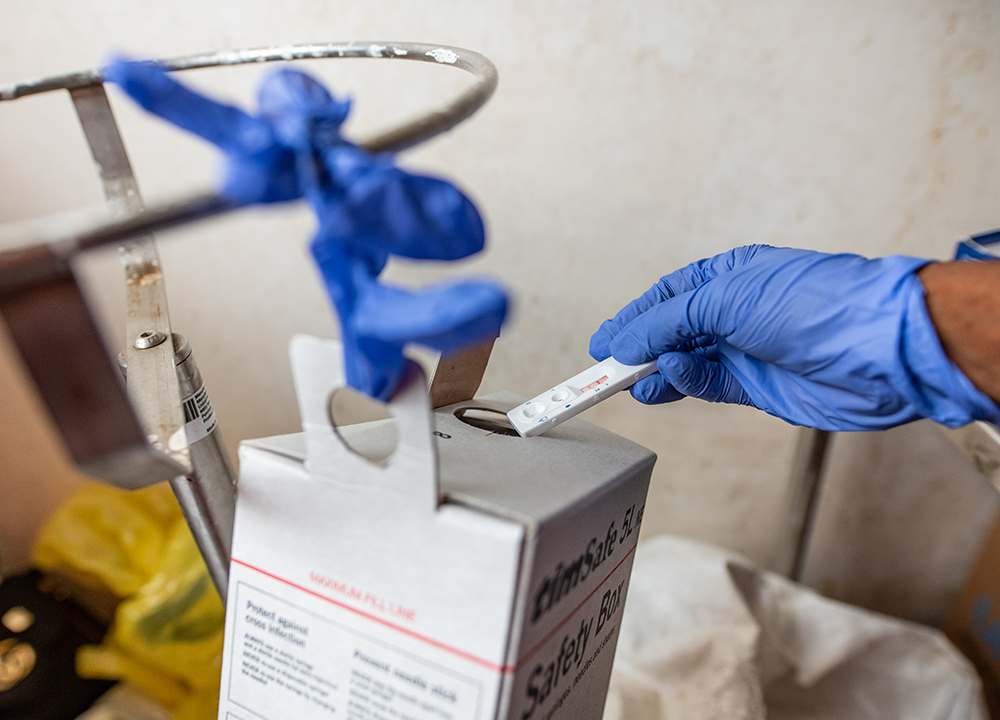
A nurse disposes of a malaria test at Waterloo Community Health Centre.
Body
At HSS 2026, Mary McPoland, Claire Lindsay and Maiwenn Kersaudy-Kerhoas presented ‘Why Is My Medical Test Cased in Plastic? The Material Histories and Futures of the Lateral Flow Assay in Global Health’ as part of Plastic Amnesias II, chaired by Anne Kveim Lie.
Why are lateral flow assays housed in plastic? Since the first ‘wand’-based pregnancy test made it into drugstores in Europe and North America in 1986, the affordable and portable lateral flow device has become the foundation of a global testing revolution that is moving the site of medical testing beyond the laboratory and into the primary care facility or patient home. But the impressive accessibility of this testing format has hidden and unpleasant consequences. The vast majority of LFAs come housed in plastic, and the huge volumes of devices that are manufactured, used and discarded each year is contributing to a growing medical waste crisis.
This presentation examined the history of this simple technology to understand why plastic cassette housing has become so ubiquitous. On the surface, this appears a straightforward story about the role of plastics in safely transitioning a technology outside of laboratory settings coupled with the growth of mass-manufacturing and global markets. But two historical glitches dog the smooth telling of this story. First, not all LFAs designed for use outside the laboratory have historically been cased in plastic. Second, tests that were once designed for testing in the wild are now making their way back into the clinical laboratory in vast quantities, carrying their hardy plastic shells with them. Making these less obvious historical tangents visible enables us to question the plastic consensus in global medical testing and opens possibilities for the engineering of more sustainable global health futures.
Read more on the double panel at HSS: here.