
Hand in glove: the history of the disposable glove at HSS 2024
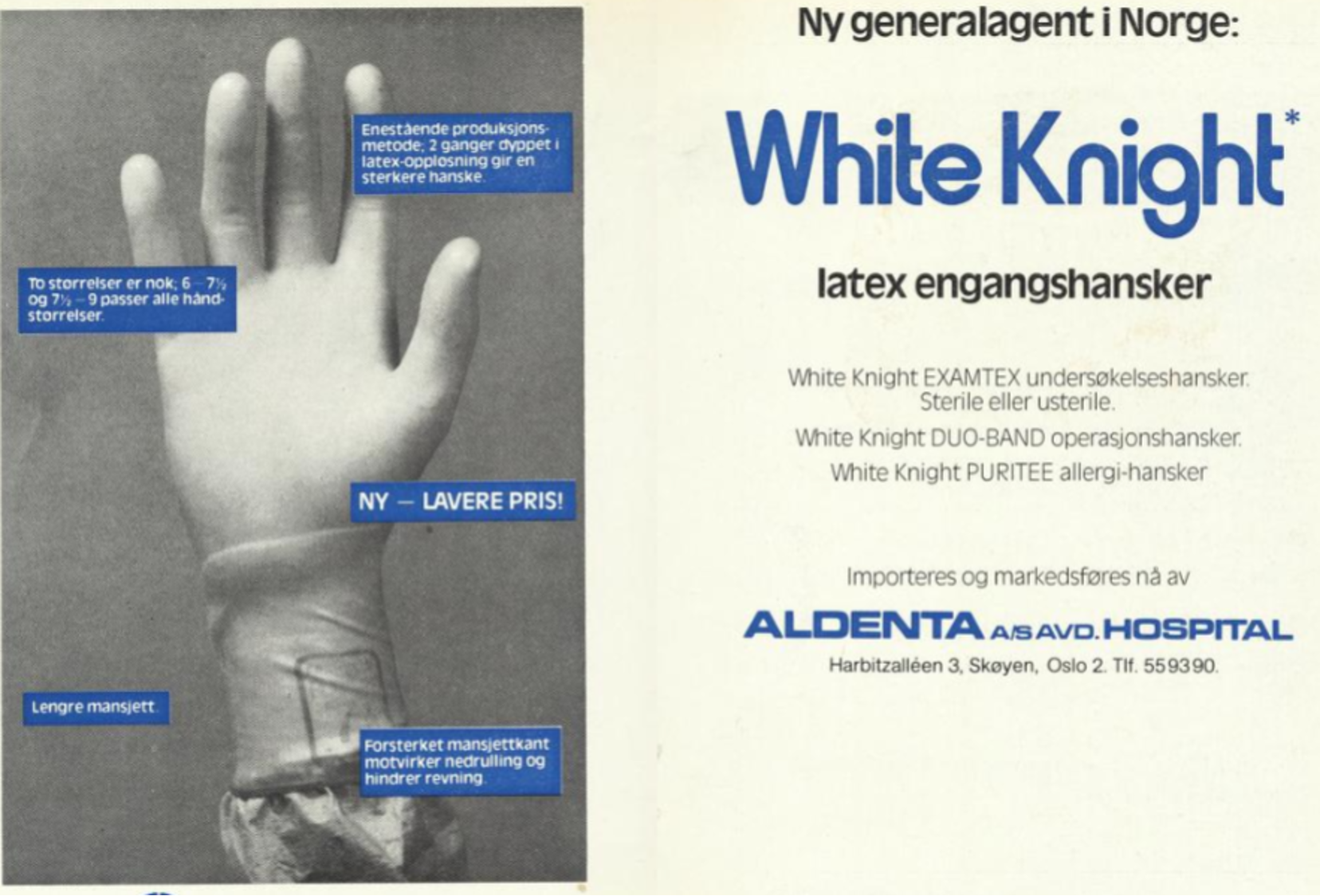
Advertisement in Norwegian for the plastic glove called "White Knight".
In November 2024, After the Single Use researcher Anne Kveim Lie presented her work at the History of Science Society (HSS) Annual Meeting, held in Mexico. Anne contributed a paper titled “Hand in glove: The history of the disposable glove”, as part of the panel Plastic Temporalities: Ecologies of Disposability in Science and Medicine, organised by Jeremy Greene.
The panel explored how, over the late twentieth century, plastics quietly replaced glass as the dominant material substrate of scientific and medical practice. While plastics inherited many of glass’s practical virtues—transparency, inertness, sterilisability—they also introduced new qualities: affordability, flexibility, and disposability. Yet as planetary health research increasingly shows, the temporal reach of plastics extends far beyond their moment of use, creating long-term environmental and health consequences through landfill accumulation, airborne toxins, ocean waste, and pervasive microplastics.
Bringing together historians and anthropologists of science and medicine, the panel examined the overlooked infrastructures of plastic use in laboratories, hospitals, and clinics across different global contexts. Contributors drew on research into the material histories of everyday disposable objects such as petri dishes, pipettes, syringes, catheters, and gloves. These objects now form part of a bioscientific waste stream linked to significant global carbon emissions.
Anne’s contribution traced the history of the disposable glove, a seemingly mundane object that has become central to contemporary healthcare practice, infection control, and clinical labour. Her research highlights how disposability has been normalised through institutional systems of procurement, regulation, and safety, and how historical analysis can help make visible the assumptions embedded in routine medical material culture.
